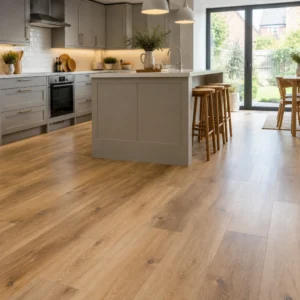
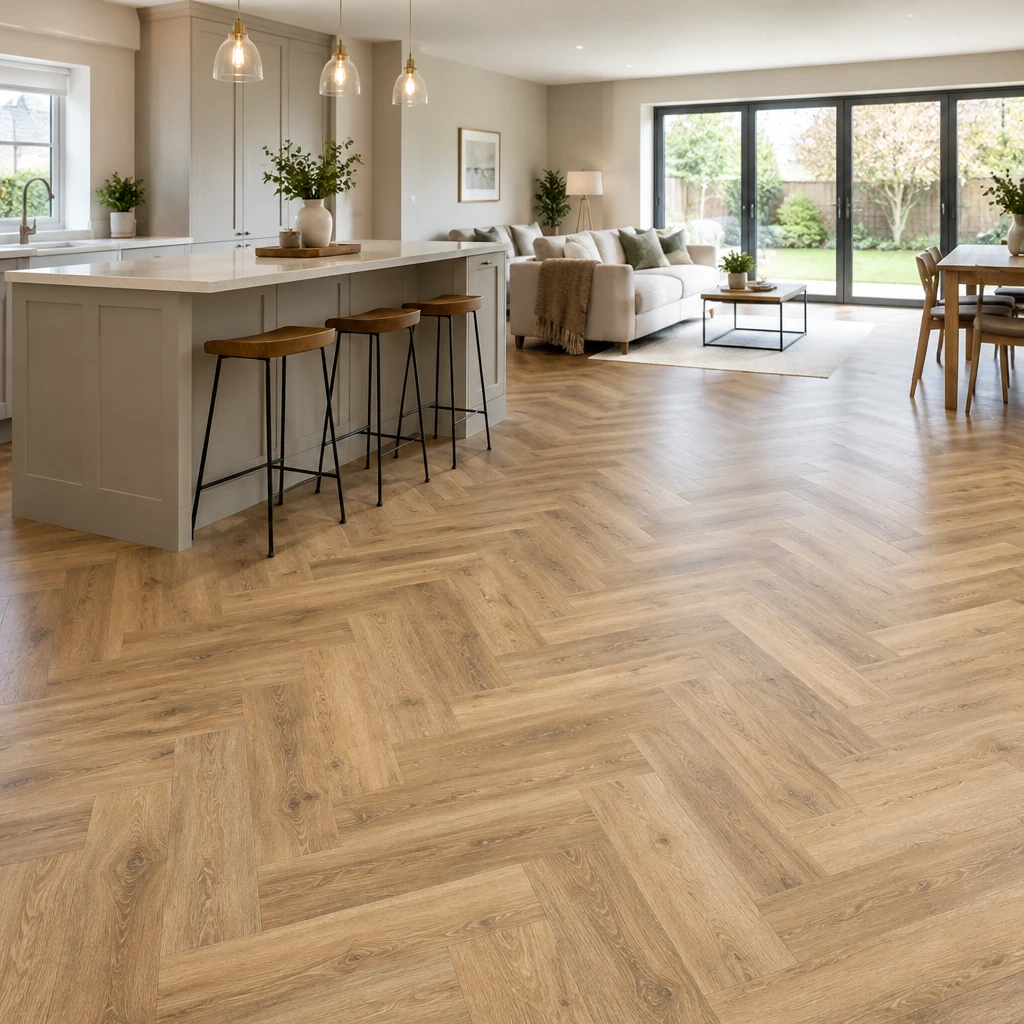
Herringbone LVT is worth considering if you want the character of a patterned wood floor with the practical maintenance of luxury vinyl tile. It can create a distinctive finish in homes and commercial interiors but it normally requires more planning and fitting time than a straightforward plank layout.
The right decision depends on the room, the condition of the subfloor, the selected LVT product and your budget. Understanding the advantages and limitations before installation can help you avoid choosing a floor for appearance alone.
Is herringbone LVT worth it?
Herringbone LVT is often worth it for people who value visual impact, easy routine cleaning and a broad choice of wood-effect designs. It is less suitable when the priority is the lowest possible fitting cost or a quick installation over an uneven surface.
The pattern uses short rectangular pieces laid at angles to form a repeated zigzag arrangement. Accurate setting out is essential because small alignment errors can become increasingly noticeable across the room. Professional fitting can therefore make an important difference to the finished appearance.
Herringbone is not automatically better than standard plank LVT. Both options can offer similar practical qualities when they come from the same product range. The main differences usually concern pattern, preparation, installation complexity and price.
What is herringbone luxury vinyl tile?
Herringbone luxury vinyl tile is an LVT floor made from individual pieces arranged so the end of one piece meets the side of another. The resulting pattern resembles traditional herringbone timber or parquet flooring.
LVT generally combines a printed decorative layer with protective and structural layers. Exact construction varies between manufacturers and product ranges. The surface can reproduce details such as timber grain, knots and tonal variation without requiring the maintenance associated with a natural wood finish.
Herringbone LVT is available in different installation formats. Common options include adhesive-fixed products and click systems. Not every range offers both formats and the correct installation method depends on the product specification as well as the room.
Herringbone compared with chevron
Herringbone pieces are rectangular and meet at staggered right angles. Chevron pieces have angled ends that meet to create continuous V shapes. The terms are sometimes used interchangeably in product descriptions but they refer to different patterns. Confirming the intended layout before ordering prevents confusion during installation.
Advantages of herringbone LVT
The main benefits of herringbone LVT are its decorative appearance, practical cleaning requirements and suitability for a range of interior styles. Product performance still depends on selecting an appropriate specification and following the installation guidance.
Distinctive appearance: The repeated pattern can turn the floor into a strong design feature without relying on rugs or additional decoration.
Choice of finishes: Wood effects range from pale oak tones to deeper shades. This makes it possible to coordinate the floor with traditional or contemporary interiors.
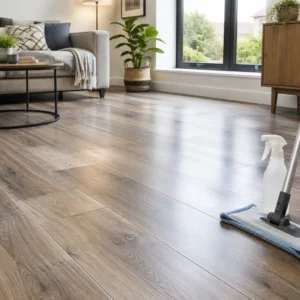
Practical routine care: Regular vacuuming or sweeping followed by cleaning with a suitable LVT product is generally straightforward.
Consistent design: LVT offers controlled colour and pattern options while still allowing variation between pieces for a more natural-looking layout.
Useful room-to-room continuity: Subject to product suitability and site conditions the same design may be used through connected living areas, hallways or commercial spaces.
Comfort underfoot: LVT usually feels less cold and hard than materials such as stone or ceramic tile although the subfloor and heating system also affect comfort.
Herringbone can also influence how a room feels visually. The angled lines draw the eye across the floor and may add movement to a simple interior. This does not physically enlarge the room but thoughtful orientation can help the layout feel balanced.
Disadvantages and risks to consider
The principal disadvantages are the more demanding installation, greater potential for visible alignment problems and possible increases in labour or material requirements. Herringbone LVT also cannot compensate for a poor subfloor.
Careful preparation is essential: Unevenness, contamination or moisture issues may affect adhesion and the finished surface. The required checks depend on the subfloor and flooring system.
Installation takes more planning: A fitter must establish accurate reference lines and maintain the pattern around walls, doorways and fixed features.
More cuts may be required: Perimeter areas and awkward room shapes can produce additional offcuts compared with a simple straight plank layout.
Mistakes are prominent: A drifting centre line or poorly matched border is often easier to spot in a geometric pattern.
Busy patterns do not suit every interior: Strong grain variation combined with herringbone geometry can feel visually crowded in rooms containing many competing finishes.
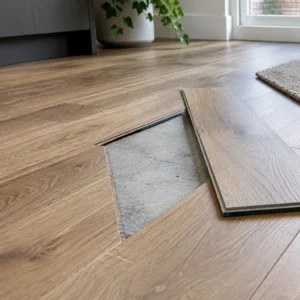
Repairs need careful matching: A damaged piece may be replaceable in some systems but access, adhesive and the availability of matching material can affect the work involved.
LVT should not be treated as a solution for active damp, movement or a structurally unsuitable base. Moisture testing and remedial preparation may be needed depending on the site. A flooring assessment can establish what is required before fitting begins.
Where does herringbone LVT work best?
Herringbone LVT works well in spaces where the pattern can be seen clearly and where practical cleaning is important. Popular locations include kitchens, dining areas, living rooms, hallways, reception areas and selected retail or office interiors.
Kitchens and open-plan living spaces
The pattern can help connect kitchen, dining and seating zones without introducing separate floor finishes. Spills should still be cleaned promptly. Suitability for kitchens and resistance to moisture must be checked against the particular product rather than assumed for all LVT.
Small or irregular rooms
Herringbone can work in a small room but the plank size and pattern orientation matter. A compact format may preserve more of the pattern before it reaches the perimeter. Numerous alcoves, curved edges or angled walls can increase cutting and make balanced borders harder to achieve.
Commercial settings
Commercial interiors need an LVT specification suited to the expected foot traffic, cleaning regime and use of the premises. Entrance matting, furniture protection and ongoing maintenance also influence how the floor performs. A product intended only for light domestic use may not be appropriate for a busy business environment.
Glue-down or click herringbone LVT?
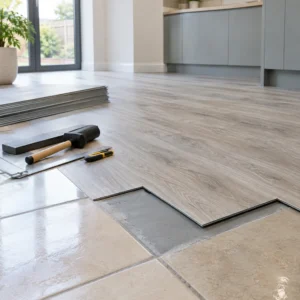
Glue-down LVT is fixed to a suitably prepared base while click LVT joins together as a floating floor. Neither method is universally best. Room shape, subfloor condition, floor height and manufacturer instructions should guide the choice.
Glue-down herringbone can provide a low-profile finish and allows individual pieces to be positioned during installation. It places significant demands on subfloor smoothness and adhesive application. The preparation process may include smoothing compounds or other treatments based on the existing surface.
Click herringbone avoids bonding every piece directly to the base but still requires a flat and stable subfloor. The locking sequence can affect how the pattern is assembled. Expansion gaps and restrictions around fixed objects must follow the flooring manufacturer’s guidance.
Underfloor heating compatibility is product-specific. The complete system must be considered including the heating type, subfloor, adhesives or underlay and permitted operating temperature. Seek advice if the property has underfloor heating rather than assuming any LVT can be installed over it.
What affects the cost of herringbone LVT?
Herringbone LVT will generally cost more to fit than a comparable straight-plank LVT product. Setting out, cutting and maintaining the pattern are more involved. The size of the premium varies with the fitting system, room shape, preparation requirements and amount of material waste so there is no universal price difference.
Product specification: Design, construction, surface finish and intended use can affect the material price.
Subfloor condition: Moisture management, smoothing or removal of unsuitable coverings can add work before installation.
Room geometry: Multiple doorways, islands, alcoves and curved edges require additional setting out and cutting.
Pattern direction: Centring the design or continuing it through several spaces may require extra planning.
Accessories: Door bars, trims, adhesives, underlay where specified and new skirting details can contribute to the overall quotation.
Site access: Furniture movement and restricted working areas may affect the installation programme.
Allowing for waste is particularly important with patterned flooring. The appropriate quantity depends on room shape and layout rather than one fixed percentage for every project. A measured survey provides a more reliable basis for ordering.
For domestic and commercial premises across Kent All Type Flooring can carry out a site survey to assess the subfloor, measure the proposed layout and discuss whether a glue-down or click product suits the space. The resulting quotation can distinguish necessary preparation costs from fitting costs so you can understand what is included and compare options more clearly.
How to decide whether herringbone LVT is right for you
Choose herringbone LVT when you want a prominent geometric floor and accept that good preparation and accurate fitting are part of the investment. Choose straight plank LVT when you prefer a calmer appearance or need a less complex layout.
Before making a final decision consider the following points:
View physical samples in the room under natural light and evening lighting.
Check that the product is specified for domestic or commercial use as required.
Ask how the pattern will be centred and oriented in relation to entrances and main sight lines.
Confirm what preparation is included after the existing floor is inspected.
Check product-specific guidance for wet areas, sunlight exposure and underfloor heating.
Discuss transitions into adjacent rooms and the finished floor height at doorways.
Keep spare pieces from the same production batch where practical for possible future repairs.
Overall herringbone LVT can be a worthwhile choice when design impact and practical care are priorities. Its value depends less on the pattern alone and more on selecting the correct product, preparing the base properly and creating an accurate layout. A site assessment and clear fitting quotation will help you compare it fairly with straight plank LVT and other flooring options.
Frequently Asked Questions
Can a single damaged herringbone LVT piece be replaced?
Replacement may be possible but the method depends on whether the floor is glue-down or click LVT and where the damaged piece is located. Matching colour and pattern can also be difficult if spare material from the original batch is unavailable. A fitter should assess the floor before any piece is removed.
Is herringbone LVT suitable for homes with pets?
It can be a practical option for homes with pets because routine cleaning is generally simple. Claws, grit, bowls and accidents can still affect a floor. Choose a product suited to the expected use then use entrance mats and protective pads while following the manufacturer’s cleaning advice.
Which direction should a herringbone pattern face?
There is no single correct direction. The layout may follow the longest sight line, lead towards a focal point or align with the main entrance. Room proportions, connected spaces and fixed features should be considered before fitting. Dry setting part of the pattern can help confirm the best orientation.
Does herringbone LVT look like real wood parquet?
Quality designs can reproduce wood colour, grain and texture convincingly but LVT is not natural timber parquet. LVT offers different maintenance and installation characteristics while real wood has natural variation and can sometimes be refinished. The better choice depends on the setting, budget and preferred material.
Arrange a Kent flooring survey and discuss herringbone LVT for your space.