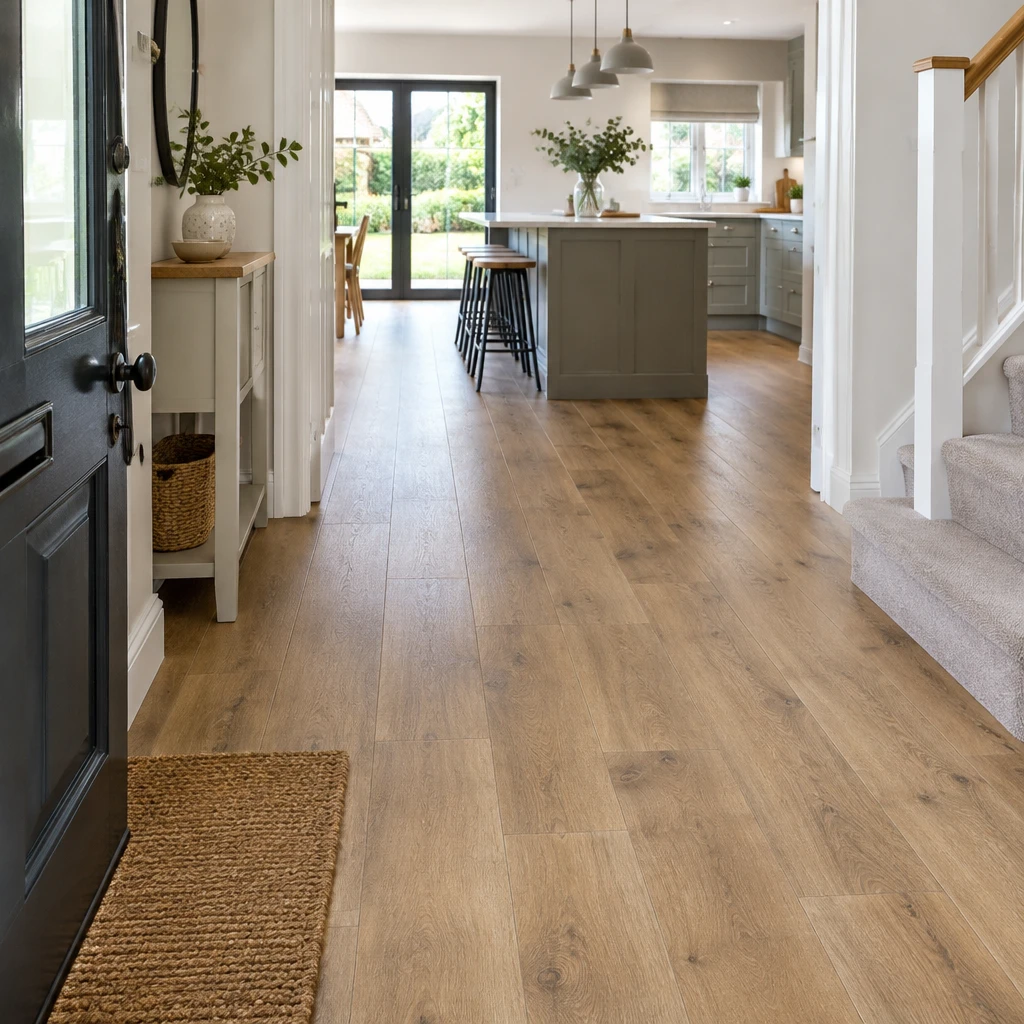
How long does LVT flooring last? As a broad planning guide rather than a guarantee, a suitable and correctly fitted LVT floor may provide around 10 to 25 years of useful service. Actual performance can fall outside this indicative range because LVT flooring lifespan depends on the selected product, usage classification, traffic, subfloor preparation, fitting and maintenance.
The estimate must be checked against the manufacturer\’s specification for the exact product. Its approved setting, fitting requirements, care instructions and warranty terms are more useful than a general industry range. A lightly used bedroom and a busy commercial entrance place very different demands on the same type of floor.
LVT means luxury vinyl tile. It is a layered resilient floor covering made in tile or plank formats which often reproduce the appearance of wood or stone. Its useful life ends when wear, damage or instability makes the floor unsuitable for the room rather than when it reaches a fixed age.
What is the typical lifespan of LVT flooring?
A broad indicative range for LVT flooring is around 10 to 25 years but it is not a promised lifespan. A suitable domestic floor with moderate traffic may sit towards the longer part of that range. LVT in a demanding commercial environment may need attention or replacement sooner because it can receive more concentrated wear.
Product-specific information should always take priority. Check whether the manufacturer approves the LVT for domestic or commercial use and whether its usage classification matches the room. Also check the required subfloor standard, installation method, cleaning guidance and any conditions attached to the warranty.
Age alone cannot show how much life an existing floor has left. A well-fitted older floor may remain stable and presentable while a newer floor can fail early if the base moves, moisture affects the system or the product is unsuitable for the level of traffic.
Does LVT last longer in homes or commercial premises?
LVT often lasts longer in a home than in a heavily used business because domestic traffic is usually less frequent and easier to control. This is not automatic. A busy household entrance can experience more grit and concentrated wear than a quiet office.
Traffic: Domestic rooms normally have periods of low use. Shops, receptions and workplaces may receive repeated foot traffic throughout their opening hours.
Entrances: External doors bring in grit, water and dirt. Commercial entrances may require more substantial matting and more frequent cleaning.
Wheeled use: Office chairs, trolleys and other wheeled equipment can create repeated local stress. Product suitability should be confirmed for the expected type of movement.
Maintenance: A commercial floor may need a planned cleaning routine because dirt can build up quickly. Domestic cleaning is usually less frequent but unsuitable chemicals or steam equipment can still damage some LVT systems.
The correct comparison is therefore between usage conditions rather than labels alone. A commercially rated product is not a guarantee of a particular service life and a domestic product should not be assumed suitable for a business simply because it looks robust.
What determines how long LVT flooring lasts?
The main influences are product specification, room use, subfloor condition, installation quality and ongoing care. These factors work together so choosing LVT by colour or overall thickness alone can lead to a poor match.
Product construction and wear layer
The wear layer is the transparent protective surface above the printed design. It helps the floor resist everyday abrasion and loss of appearance. A more robust wear layer can be beneficial in a busy area but wear-layer thickness is not the only measure of quality.
The complete construction, surface treatment and approved usage classification also matter. The selected LVT should be suitable for the property type and the actual intensity of use. Manufacturer documentation can help confirm whether a product is intended for a bedroom, active living space or commercial setting.
Traffic and room conditions
Entrances, kitchens, corridors and open-plan living areas tend to receive concentrated traffic. Pets, children, heavy furniture and home working can also increase wear in domestic properties. Commercial reception areas and retail premises may face outdoor grit plus repeated movement along the same routes.
Sunlight, temperature changes and point loads can affect some floors. Underfloor heating compatibility must be confirmed for the chosen product. Installation, commissioning and temperature limits should follow the relevant manufacturer guidance and the design of the heating system.
Subfloor preparation and fitting
A stable and suitably prepared subfloor supports long-term LVT performance. Unevenness can become visible through some products while contamination, movement or excess moisture can affect adhesion and joint stability.
Preparation depends on the existing base and the selected flooring system. Concrete, screed, timber and existing hard floors can require different work. A site assessment is needed to establish whether smoothing, repairs or moisture management are required. The necessary preparation cannot be confirmed reliably from room measurements or photographs alone.
Does glue-down or click LVT last longer?
Neither glue-down nor click LVT is always longer lasting. The appropriate choice depends on the subfloor, room layout, expected traffic and the individual manufacturer\’s requirements.
Glue-down LVT is bonded to a suitably prepared base. It can provide a stable finish in busy spaces or larger areas but its performance depends heavily on careful preparation and the correct adhesive system. Removing or replacing bonded pieces also requires appropriate methods.
Click LVT uses interlocking edges and is generally installed as a floating floor. It can suit many domestic rooms but needs a sufficiently level base plus the correct expansion provision. Room shape, fixed units, thresholds and temperature changes must be considered because a floating floor needs to move as designed.
The product specification remains more important than a general assumption about the format. A properly selected click floor can outlast unsuitable glue-down LVT and the reverse can also be true.
How can everyday conditions shorten LVT lifespan?
Abrasive dirt, unsuitable cleaning and repeated local pressure are common causes of premature surface deterioration. Preventing these stresses helps preserve appearance and serviceability.
Grit and debris: Small particles can scratch the finish when repeatedly walked across.
Furniture movement: Dragging furniture or using damaged protective pads can mark or gouge the surface.
Point loads: Heavy items on narrow feet can create local pressure or indentation.
Wheeled equipment: Repeated chair or trolley movement may wear concentrated routes if the product is not suitable.
Spills and moisture: Spills should be removed promptly. Surface water resistance does not protect every joint, edge or subfloor condition.
Incorrect cleaning: Harsh chemicals, steam cleaning and excessive water may be unsuitable for a particular LVT system.
Direct sunlight: Strong exposure can affect colour or temperature depending on the flooring and glazing.
Use compatible entrance matting because some backing materials can react with particular vinyl surfaces. The flooring manufacturer\’s maintenance instructions should take priority over general cleaning advice.
How can you help LVT flooring last longer?
Regular removal of grit plus product-appropriate cleaning can reduce avoidable wear. The objective is to keep abrasive debris away from the surface without leaving residues or exposing the floor to excessive water.
Use effective entrance matting to capture moisture and outdoor dirt.
Vacuum or sweep with equipment intended for hard flooring.
Use the cleaning method recommended for the specific LVT.
Fit protective pads beneath furniture and inspect them for trapped grit.
Lift furniture instead of dragging it across the floor.
Use suitable protection beneath frequently moved office chairs where recommended.
Deal with spills promptly and investigate recurring moisture.
Keep spare planks or tiles from the original batch where practical.
Maintenance cannot correct a fundamental installation or subfloor problem. Persistent lifting, movement or joint separation should be investigated rather than repeatedly cleaned, pressed down or covered.
Can damaged LVT be repaired instead of replaced?
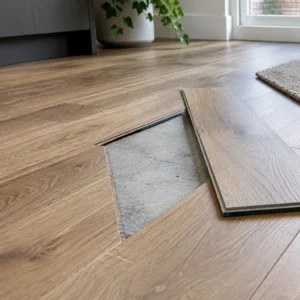
Localised LVT damage can sometimes be repaired by replacing individual planks or tiles. The practicality of a repair depends on the installation method, position of the damage, condition of the surrounding floor and availability of matching material.
An experienced fitter may be able to lift and replace a damaged glue-down piece. Repairing click LVT can be more involved because sections may need to be dismantled to reach the affected plank. Access and the risk of disturbing adjacent joints must be assessed first.
A replacement piece may look different because product ranges change and older flooring can be affected by wear or daylight. Keeping spare material from the installation batch improves the chance of a close match.
Repeated lifting or separation may point to moisture, movement, inadequate preparation or restricted expansion. Replacing the visible plank without identifying the cause could allow the problem to return.
When should LVT flooring be replaced?
LVT should be considered for replacement when widespread wear, damage or instability affects safe use, effective cleaning or the required appearance. A floor does not need replacing solely because it has reached a particular age.
Warning signs include extensive loss of the surface finish, deep scratches, damaged edges, persistent gaps, lifting sections and movement underfoot. Recurring discolouration or contamination that cannot be cleaned effectively can also influence the decision.
Some symptoms require an on-site assessment. Moisture conditions, subfloor stability and installation details may need to be reviewed before deciding between local repair and complete replacement. Commercial clients should also consider customer-facing appearance, operational demands and how flooring work will affect access.
Choosing LVT for a realistic long-term result
Long-term value comes from matching the flooring to the room and fitting it over a suitable base. The thickest or most expensive option is not automatically the longest lasting.
All Type Flooring provides fitted LVT flooring for domestic and commercial clients in Kent. During a project discussion the intended room use, traffic, entrances, furniture and maintenance needs can be considered. A site assessment allows the existing base, thresholds, adjoining levels and likely preparation requirements to be reviewed before fitting.
The selected product\’s specification and warranty terms should then be checked against those site conditions. Preparation requirements and fitting choices depend on the property so they should be confirmed for the individual project rather than assumed. This process gives a more useful expectation of LVT lifespan than relying on a broad number alone.
Frequently Asked Questions
Does thicker LVT always last longer?
No. Overall thickness is only one part of the specification. The wear layer, complete product construction, usage classification, subfloor preparation and fitting quality can all influence long-term performance.
Can LVT be installed in a kitchen or bathroom?
Many LVT products are suitable for kitchens and some are approved for bathrooms. Suitability depends on the exact product, fitting system, subfloor conditions and manufacturer instructions. Water resistance should not be treated as protection against every moisture problem.
Does LVT fade in sunlight?
Strong or prolonged sunlight can affect some LVT over time. The result depends on the product, glazing and room conditions. Window coverings may reduce intense exposure but the selected flooring manufacturer\’s guidance should be checked.
Does a long LVT warranty mean the floor will last that long?
Not necessarily. A warranty states defined cover under particular conditions rather than guaranteeing the date on which a floor will need replacement. Check the approved usage classification, installation requirements, maintenance obligations, exclusions and whether cover changes over time.
Arrange an LVT flooring consultation for your Kent property.