Yes, you can fit carpet over a concrete floor provided the concrete is dry, clean, sound and sufficiently level. The correct preparation and fitting method depend on the condition of the subfloor, the room\’s intended use and whether moisture is present.
Concrete is common in ground-floor rooms, extensions, flats and commercial premises. It can provide a stable base for carpet but carpet should not simply be laid over an unassessed slab. Moisture, cracks, surface contamination and uneven areas can affect the underlay, adhesive and finished appearance. A professional flooring assessment helps identify what preparation is required before installation begins.
What condition must a concrete floor be in?
A concrete subfloor should be dry, firm, clean and reasonably smooth before carpet is fitted. Small surface variations may be manageable but pronounced ridges, holes or damaged sections usually need attention.
The main conditions to assess are:
Moisture: The slab must be tested where there is any uncertainty about residual construction moisture or moisture rising from below.
Surface strength: Loose material, flaking areas and weak surface laitance can prevent primers or adhesives from bonding correctly.
Flatness: High spots and depressions may become noticeable through the finished carpet or affect how the underlay sits.
Cleanliness: Dust, paint, plaster, oil and old adhesive residue can interfere with floor preparation products.
Cracks: Cracks should be investigated rather than automatically covered. Some are stable surface defects while others may indicate continuing movement.
A newly poured concrete floor also needs sufficient time to dry. The required period varies with slab thickness, ventilation, temperature and construction conditions. Time alone does not confirm that a slab is ready for flooring so an appropriate moisture test may still be necessary.
How to fit carpet over a concrete floor
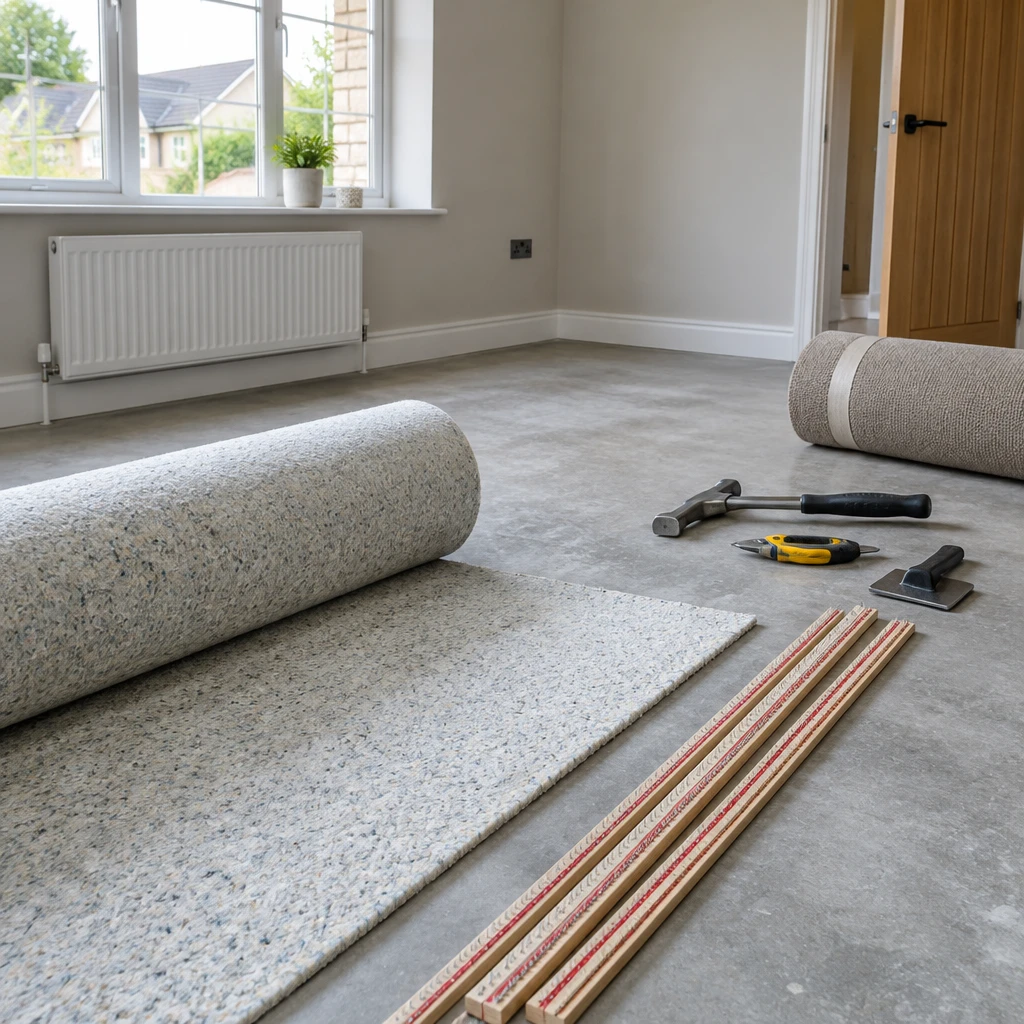
Carpet can be installed over concrete using gripper rods and underlay or with an adhesive system. The best method depends on the carpet type, expected foot traffic and room layout.
Carpet grippers with underlay
For many domestic rooms the fitter secures suitable carpet grippers around the perimeter, installs underlay and stretches the carpet into place. Fixings designed for concrete may be required because standard nails intended for timber floors are not suitable for every concrete slab.
The grippers create the correct edge detail while the underlay provides cushioning and helps the carpet feel more comfortable underfoot. Door thresholds, radiator pipes and transitions to other floor finishes must also be planned as part of the installation.
Direct-stick and double-stick systems
Some carpets are bonded directly to a prepared concrete base. In a double-stick installation the underlay is adhered to the subfloor then the carpet is bonded to the underlay. These methods are often considered for commercial environments or areas where greater dimensional stability is needed.
Adhesive installation requires a clean and suitably prepared surface. The adhesive, carpet backing, underlay and any primer or smoothing compound must form a compatible system. Product instructions and site conditions determine which materials can be used.
Why moisture testing matters before carpet fitting
Moisture is one of the most important risks when fitting carpet over concrete. A slab may look dry at the surface while still containing enough moisture to affect flooring materials. Ground-bearing slabs may also be vulnerable if an effective damp proof membrane is absent, damaged or uncertain.
Excess moisture can contribute to adhesive failure, unpleasant odours, deterioration of some carpet backings and damp conditions beneath the floor covering. Covering the slab does not solve the source of the moisture.
A flooring professional may recommend a recognised moisture assessment based on the construction and proposed installation system. If readings are too high a suitable surface damp proof membrane may be considered. The correct treatment depends on the test result, slab condition and compatibility with the products being installed. Active leaks, water ingress or wider building defects should be resolved before flooring work proceeds.
Older properties require particular care because the floor build-up may not be obvious. Where old adhesives, tiles or other suspect materials could contain asbestos they should not be sanded, scraped or mechanically disturbed until appropriate advice or testing has been obtained.
Does concrete need underlay beneath carpet?
Most conventional domestic carpets benefit from a suitable underlay but the choice depends on the carpet and fitting method. Underlay can improve comfort, provide support and add some thermal or acoustic benefit. It does not replace moisture control or repair an unsuitable subfloor.
The underlay should be compatible with the carpet manufacturer\’s guidance and appropriate for installation over concrete. Important considerations include:
The carpet backing and intended fitting method
Expected foot traffic in the room
Door clearance and adjacent floor heights
Use with underfloor heating
Acoustic requirements in flats or multi-use buildings
Suitability for castor chairs or concentrated commercial use
A very thick or soft underlay is not automatically the best option. An unsuitable combination may provide inadequate support or make doors and transitions difficult to finish. Commercial carpet tiles and some contract carpets may use a different installation system with no separate cushioned underlay.
How is an uneven concrete floor prepared?
An uneven concrete floor is normally repaired and smoothed before carpet installation. Carpet and underlay can disguise minor visual variation but they cannot reliably correct significant hollows, ridges or loose concrete.
Preparation may include vacuuming, removing contaminants, treating cracks, applying a compatible primer and using a smoothing compound. High areas may need controlled mechanical preparation. The precise process depends on the slab and any existing coatings or residues.
Smoothing compounds are designed to create a more suitable surface for flooring. They are not a universal remedy for structural movement, major level differences or ongoing damp. Deep repairs may need a separate repair product and unstable cracks may require further investigation.
Floor preparation also affects the final height of the carpet. The fitter should account for door leaves, skirting details, kitchen plinths and junctions with LVT, tiles or timber flooring. Planning these details before installation helps avoid abrupt transitions and restricted doors.
Can carpet be fitted over concrete with underfloor heating?
Carpet can be used over some concrete floors with underfloor heating when the complete flooring system is suitable. The carpet and underlay both resist heat transfer so their combined thermal resistance must be considered against the heating system designer\’s requirements.
Choose products approved by their manufacturers for the relevant type of underfloor heating. The heating system should be commissioned and operated in line with the system guidance. Adhesives and floor preparation products must also be suitable for the expected temperature conditions.
Heating should not be used as a shortcut to force-dry a slab unless the construction and heating instructions specifically permit the process. Moisture testing remains important because a warm surface does not necessarily mean the full floor construction is dry.
Common mistakes when laying carpet on concrete
The most common mistakes involve covering the floor before its condition has been properly assessed. Avoiding these errors can reduce the risk of preventable problems:
Skipping moisture checks: A visual inspection cannot confirm the moisture condition inside a slab.
Using underlay as a levelling layer: Underlay follows the shape of the subfloor and does not repair significant defects.
Installing over dust or contamination: Adhesives and primers need a properly prepared surface.
Using unsuitable fixings: Concrete requires an appropriate gripper fixing method that does not damage hidden services or the floor construction.
Ignoring floor height: Carpet, underlay and preparation layers can affect doors, thresholds and transitions.
Assuming every crack is harmless: Cracks should be assessed for movement and possible moisture entry.
Selecting products separately: Carpet, underlay, adhesive, primers and smoothing products need to be compatible.
When should you use a professional carpet fitter?
Professional fitting is advisable when moisture levels are unknown, the concrete is uneven or the room has underfloor heating. It is also useful for large spaces, commercial premises and areas with complex doorways or flooring transitions.
A fitter can assess the subfloor, recommend an appropriate installation method and identify preparation that may be needed. The assessment should consider how the room will be used rather than focusing only on the carpet\’s colour or texture. A busy office may require a different carpet and fitting system from a bedroom or lounge.
All Type Flooring supplies and fits carpet for homes and businesses in Kent. A site visit can establish whether the concrete is ready for carpet or whether moisture management, repairs or smoothing should be completed first. Final recommendations will depend on the property, subfloor readings and selected flooring system.
With a dry and properly prepared concrete base carpet can create a comfortable finish in domestic and commercial spaces. The key is to treat subfloor assessment as part of the installation rather than covering problems and hoping they remain hidden.
Frequently Asked Questions
Can carpet be laid directly onto bare concrete without underlay?
Some commercial and specialist carpets can be bonded directly to properly prepared concrete. Most conventional domestic carpets are fitted with suitable underlay for support and comfort. The carpet manufacturer\’s instructions and intended use should determine the method.
Will carpet make a concrete room feel warmer?
Carpet and underlay can reduce the cold sensation associated with a bare concrete surface. Actual room warmth also depends on insulation, heating, ventilation and the wider building construction.
Can carpet be installed over painted concrete?
Possibly but the paint must be sound and compatible with the proposed preparation or adhesive system. Loose, glossy or contaminated coatings may need removal or specialist preparation before carpet fitting.
Should skirting boards be fitted before or after the carpet?
Carpet is commonly fitted after skirting boards are installed. The correct gap and finishing detail depend on the carpet thickness, underlay and room design so coordination with the fitter is recommended.
Arrange a concrete subfloor assessment and carpet fitting quote in Kent.