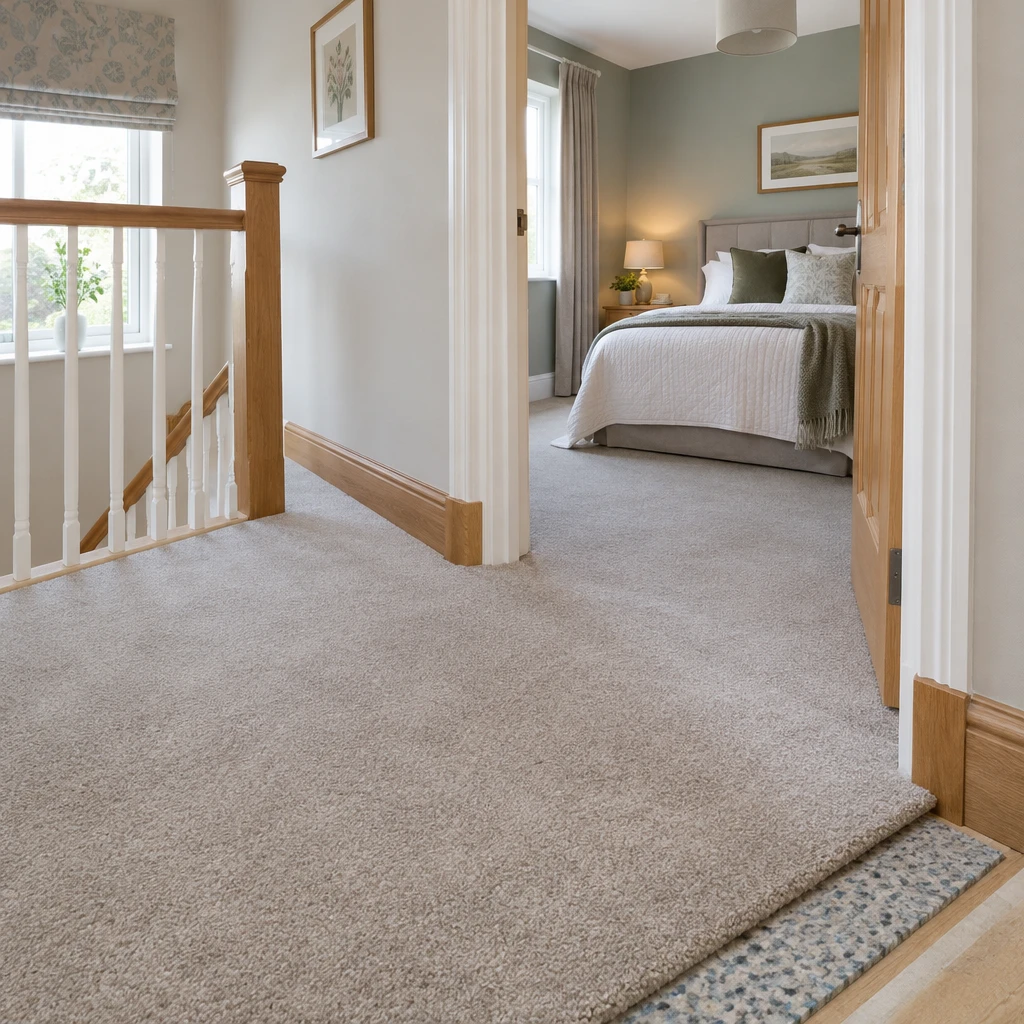
Yes. Fitted carpet can reduce noise by cushioning footsteps and absorbing some sound within a room. Many homeowners asking whether carpet can reduce noise are mainly concerned about footsteps from above or sound travelling into neighbouring rooms. Carpet is particularly useful for reducing impact noise but it does not completely soundproof a floor or fix every route through which sound can travel.
The result depends on the carpet construction, underlay, quality of fitting and the structure beneath the flooring. Doors, walls, floor voids and gaps around services can also affect how much sound reaches another room. Understanding the source and type of noise is therefore the first step towards choosing an appropriate flooring system.
How can carpet reduce noise in a property?
Carpet reduces noise in two main ways. Its soft surface cushions contact between feet or objects and the floor. Its fibres also absorb some sound that would otherwise reflect from a hard surface back into the room.
This can make a bedroom, landing, lounge or office feel quieter. Footsteps may sound less sharp and conversations can create less reverberation within the carpeted room. A suitable underlay can add further cushioning between the carpet and subfloor.
However carpet is not the same as a complete acoustic insulation system. It is generally more effective against sounds caused by contact with the floor than against loud voices, televisions or music passing through the building structure.
Impact noise and airborne noise are different
Impact noise is created when an object makes direct contact with part of the building. Airborne noise begins in the air before reaching floors, walls or ceilings. Identifying which type is causing the problem helps establish whether a carpet change is likely to make a worthwhile difference.
Impact noise
Examples include footsteps, dropped items, moving chairs and children playing on the floor. Carpet and underlay can be effective surface treatments for this type of noise because they soften the initial impact. This is often the main reason carpet is selected for upper-floor bedrooms and circulation areas.
Airborne and flanking noise
Voices, television sound and music are common forms of airborne noise. Carpet may absorb some sound within the source room but airborne noise can still pass through ceilings, walls, door gaps and openings around pipes.
Flanking noise follows an indirect route through connected parts of a building. Sound might travel through a floor void before emerging beside a wall or through another room. Carpet alone is unlikely to resolve a significant flanking noise problem. Investigation of the floor and wall construction may be needed.
What affects the acoustic performance of carpet?
No single carpet produces the same result in every property. The complete build-up and the condition of the existing floor matter as much as the visible surface.
Carpet construction: A denser or more substantial textile surface may absorb more room sound and soften impacts better than a very light floor covering. Suitability must still be balanced against wear, cleaning and room use.
Underlay: A compatible underlay can improve cushioning and help reduce impact noise. The thickest option is not automatically the best choice for every carpet or subfloor.
Subfloor condition: Loose boards, movement and uneven areas can create squeaks or knocks that new carpet will not necessarily cure. Preparation may be required before fitting.
Floor structure: Timber joists and floorboards behave differently from a solid concrete floor. Voids and structural connections affect how vibration travels.
Installation quality: Secure fitting, suitable grippers and careful treatment of joins help the flooring system perform as intended.
Other sound paths: Lightweight doors, open doorways and gaps around building services can allow sound to bypass the carpeted floor.
Why carpet underlay matters for noise reduction
Underlay forms a resilient layer beneath fitted carpet. It can soften footfall, improve comfort and reduce direct impact on the subfloor. It can also support the carpet subject to the carpet manufacturer\’s fitting requirements.
Underlay should be chosen as part of the whole flooring system rather than by thickness alone. Density, resilience and intended use all matter. A domestic bedroom may have different needs from a busy office or commercial corridor. Furniture with castors, frequent traffic and cleaning methods may influence the specification.
Some products provide acoustic test information. Impact sound improvement may be expressed using technical measurements such as ΔLw while other figures can relate to airborne sound. Test results only apply to the particular construction and test conditions used. They should not be treated as a promise of identical performance in a different property.
Compatibility also matters where there is underfloor heating. Carpet and underlay add thermal resistance so the combined system must be suitable for the heating design and floor finish requirements. Product guidance or professional advice should be checked before installation.
Reducing noise between upper and lower floors
Carpet with a suitable underlay is often a practical first measure for reducing footfall heard in the room below. It deals with the impact at the upper surface before as much vibration enters the floor structure. The improvement will depend on whether the floor is timber, concrete or another construction.
Older timber floors may contain loose boards, gaps or services within the void. These can contribute to noise but they should not be altered without understanding their purpose and condition. Pipes, cables, ventilation routes and fire protection measures may be present. Significant work inside a floor should be assessed by an appropriate professional.
A concrete floor has more mass than a typical timber deck but impact noise can still travel through it and into connected walls. Carpet can soften the source of the impact while other acoustic layers may be needed where stricter performance is required.
In a flat or leasehold property the lease, freeholder\’s rules or managing agent\’s policy may specify permitted floor finishes or acoustic standards. Approval may be required before replacing carpet with another material. Building Regulations can also apply to certain new-build, conversion or alteration projects. The exact position depends on the property and proposed work.
Will carpet stop noise travelling between adjoining rooms?
Carpet can reduce reflected sound within a room and soften movement across the floor. This may lower the amount of sound generated at source. It will not normally stop conversations travelling through a thin partition or around a poorly sealed internal door.
For noise between adjoining rooms it is worth checking the whole route. Common weak points include door gaps, lightweight hollow doors, openings around pipes and sockets positioned back-to-back in a partition. Sound can also pass through a shared ceiling void.
Carpeting both rooms may improve their general acoustic character but a persistent privacy problem may require work to the door, partition or ceiling. The correct solution depends on the construction. Randomly sealing openings or adding materials can create fire safety, ventilation or moisture risks so professional assessment is sensible for complex problems.
Carpet compared with LVT for a quieter floor
Carpet is usually the more naturally cushioned surface and is often preferred where reducing footfall and room reverberation are leading priorities. Luxury vinyl tile offers a firmer finish with practical cleaning benefits and a wide range of visual options. The better choice depends on the room rather than acoustics alone.
Some LVT products include an acoustic backing or are designed for use with a specific underlay. Only approved combinations should be installed because an underlay that is too soft can affect joints or stability. LVT also requires a smooth and properly prepared subfloor.
For bedrooms and quiet relaxation spaces carpet may offer the desired warmth and softer acoustic feel. LVT may be more appropriate in kitchens, entrance areas or commercial spaces where maintenance and resistance to everyday use take priority. Using different flooring types across a property can balance noise, comfort and cleaning needs.
How to choose carpet for a noise-sensitive room
Start by identifying the noise and where it originates. A surface solution may be suitable for footsteps while structural or airborne noise may need a wider investigation.
Listen for whether the problem is footfall, voices, vibration or creaking floorboards.
Check the condition and type of subfloor before selecting carpet or underlay.
Consider how busy the room is and whether the carpet must cope with heavy domestic or commercial traffic.
Ask whether underfloor heating, wheelchair use or castor chairs affect the specification.
Review lease conditions or property management requirements where relevant.
Compare the complete carpet and underlay combination rather than choosing either component in isolation.
Arrange accurate measurement and floor preparation before fitting.
For commercial premises the decision may also involve cleaning regimes, access needs, fire performance and disruption during installation. These requirements vary by site and should be confirmed as part of the flooring specification.
A professional flooring assessment can establish whether fitted carpet is suitable and identify preparation work that may otherwise be missed. All Type Flooring supplies and fits carpet for domestic and commercial properties in Kent with advice based on the room, subfloor and intended use.
Frequently Asked Questions
Can a rug reduce noise if fitted carpet is not suitable?
A substantial rug with a compatible rug pad can soften footsteps and reduce some reflected sound. It will usually cover less of the floor than fitted carpet so noise can still be generated around its edges. Rugs must also be positioned securely to reduce slip and trip risks.
Will carpet stop voices from being heard downstairs?
Carpet may absorb some sound within the room but voices are airborne noise and can pass through the floor structure, walls and gaps. If speech remains clearly audible downstairs an acoustic assessment may be needed to identify the transmission path.
Do I need permission to fit acoustic underlay in a flat?
Permission depends on the lease and the rules set by the freeholder or managing agent. Some buildings require details of the proposed carpet and underlay before work begins. Always check the relevant documents rather than assuming a soft floor finish is automatically approved.
Can carpet be fitted over a squeaky timber floor?
It can be fitted after the floor has been assessed but carpet may only muffle the squeak rather than remove its cause. Loose boards or movement may need attention first. The location of pipes and electrical cables must be checked before boards are secured.
Arrange a Kent carpet consultation for advice on flooring, underlay and fitting.