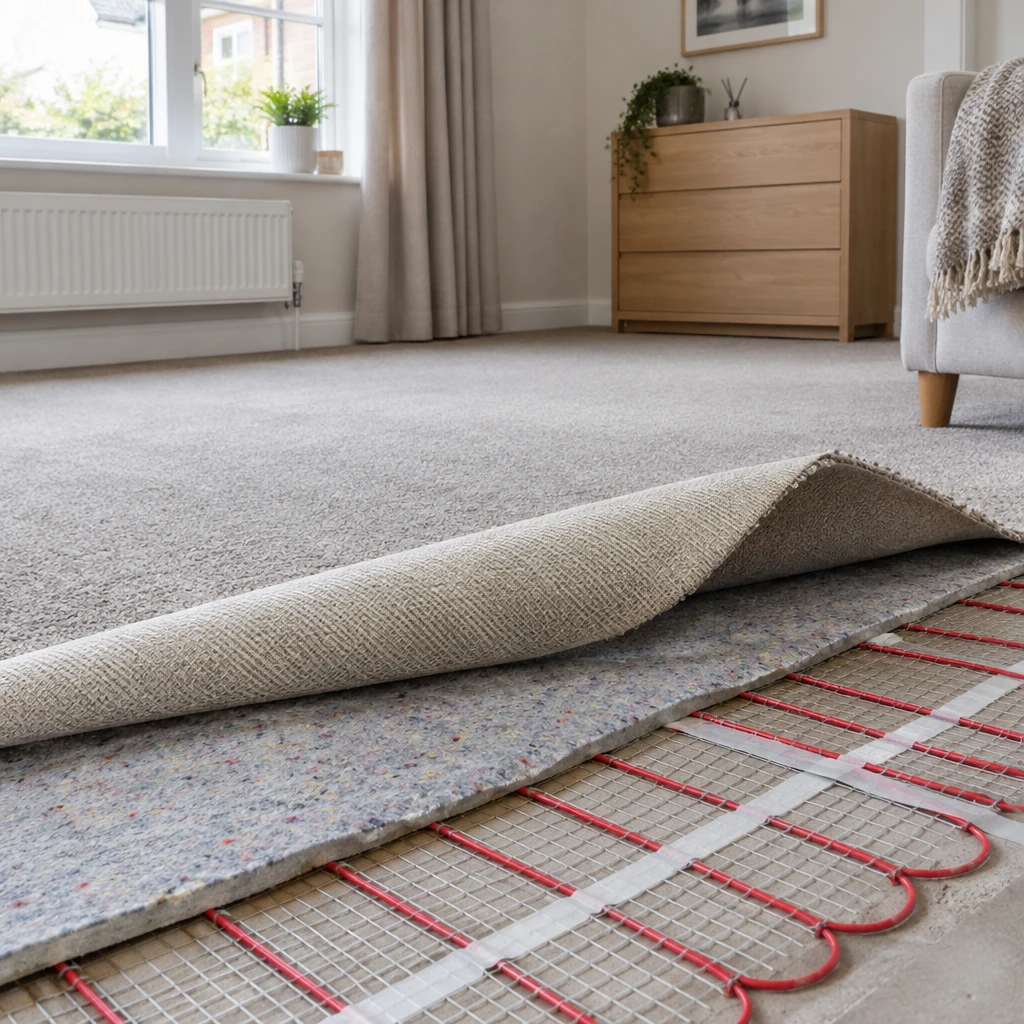
Yes, you can use carpet with underfloor heating when the carpet and underlay are suitable for the heating system. The key issue is thermal resistance. A thick carpet or highly insulating underlay can restrict heat transfer and make the system slower or less effective.
Before choosing a floor covering, check the guidance from the underfloor heating manufacturer and the carpet and underlay manufacturers. The combined thermal resistance must remain within the limit specified for the system. Subfloor condition, room heat loss and temperature controls also affect whether a proposed combination is appropriate.
Can You Use Carpet With Underfloor Heating Safely?
Carpet can be a safe and practical finish over compatible electric or water-based underfloor heating. Suitability depends on the complete floor build-up rather than the carpet alone. The heating system, subfloor, any levelling materials, underlay and carpet must work together.
Manufacturers commonly express the insulating effect of carpet and underlay using a tog rating. A higher tog value means greater resistance to heat passing through the floor covering. Many underfloor heating systems use a combined carpet and underlay limit of around 2.5 tog. However, this is a common benchmark rather than a universal rule. The heating system manufacturer\’s instructions should always take priority.
Carpet should also be clearly described as suitable for use with underfloor heating. If the product information is unclear, ask the flooring supplier or manufacturer before ordering. Assumptions based only on carpet thickness can be misleading because fibre type, density and construction all influence thermal resistance.
How Tog Ratings Affect Heat Transfer
The combined tog rating is the total thermal resistance of the carpet and underlay. Both figures must be considered. A low tog carpet placed over a thick insulating underlay may still prevent the heating system from operating as intended.
For example, if a carpet has a stated tog rating of 1.5 and the underlay is rated at 0.8 tog, the combined value is 2.3 tog. That may suit a system allowing up to 2.5 tog but the system documentation must still be checked. Other layers in the floor build-up can also affect performance.
A lower combined rating generally allows heat to enter the room more readily. This does not mean the lowest possible rating is automatically best. The flooring still needs to meet the household\’s requirements for comfort, appearance, acoustic performance and wear.
Why carpet thickness is not the only factor
Two carpets of a similar thickness can have different tog ratings. A dense pile may resist heat more than a less dense construction. Backing materials can also influence suitability. Product-specific technical information is therefore more useful than judging a carpet by touch or appearance.
Why the underlay matters
Underlay supports the carpet and can improve comfort underfoot. Traditional thick underlays are not always appropriate above underfloor heating because they can act as an insulating barrier. A purpose-designed low tog underlay is normally the better option where compatibility has been confirmed.
Which Carpet Types Work Best?
Carpets with a relatively low tog rating and manufacturer approval for heated floors are usually the most suitable. The right choice will depend on the room, expected foot traffic and the type of underfloor heating.
Possible options include:
Low tog synthetic carpets designed for efficient heat transfer
Suitable wool or wool-blend carpets with a confirmed tog rating
Shorter pile constructions that remain within the system limit
Carpets with backings approved for the intended heating system
Products supplied with clear underfloor heating guidance
Natural wool is an effective insulator but that does not automatically make every wool carpet unsuitable. Some wool and wool-blend products can be used if their thermal resistance is within the permitted limit. Equally, a synthetic carpet is not automatically compatible. Always check the individual specification.
Very thick carpet, dense felt-backed products and deep luxury underlays may reduce heating efficiency. If softness is a priority, the carpet fitter can help identify a balanced combination that provides comfort without exceeding the heating system\’s limit.
Electric and Water Underfloor Heating
Carpet may be fitted over both electric and water underfloor heating but the design and operating requirements differ. The heating provider\’s instructions should be reviewed before flooring work begins.
Electric underfloor heating
Electric systems may use heating cables or mats installed within or beneath a suitable layer. Temperature controls are particularly important because the floor covering must not be exposed to temperatures above its approved limit. A correctly positioned floor sensor and compatible thermostat may be required by the system manufacturer.
The heating elements must be fully protected and the surface must be stable, dry and sufficiently smooth for the proposed flooring method. Carpet grippers or other fixings must never be installed where they could damage heating cables. The installer needs accurate information about cable positions and safe fixing zones.
Water-based underfloor heating
Water-based systems circulate heated water through pipes within the floor construction. These systems are often set within screed although other build-ups are available. Before carpet fitting, the screed must be properly cured and sufficiently dry for flooring installation.
The system should have been commissioned in line with the heating designer\’s instructions. Heat output calculations should account for the carpet and underlay because a more insulating finish can change system performance. A heating engineer should assess any concern about output, controls or water temperature.
What Should Be Checked Before Carpet Fitting?
Before fitting carpet over underfloor heating, confirm product compatibility, total tog value, subfloor condition and installation requirements. These checks reduce the risk of poor heat transfer or avoidable damage.
Heating system instructions: Identify the maximum permitted thermal resistance and floor surface temperature.
Carpet specification: Obtain the product\’s tog rating and written suitability guidance.
Underlay specification: Select an underlay designed for heated floors and include its tog value in the total.
Subfloor moisture: New screed and smoothing compounds must meet the relevant moisture requirements before fitting.
Floor condition: The surface should be level, sound and free from defects that could affect the installation.
Fixing method: Gripper positions and other fixings must not risk puncturing pipes or electrical elements.
Heat output: The heating design must be capable of warming the room through the selected floor covering.
Controls: Thermostats and floor sensors should be correctly configured for the carpet and system.
If the heating layout is unknown, fitting should not proceed on guesswork. Original plans, installation photographs or specialist detection may be needed. Electrical checks must be completed by a suitably qualified person where required. Heating design questions should be referred to the system installer or heating engineer.
Installation and Heating Start-Up
Underfloor heating is normally switched off or reduced before carpet fitting so the floor can reach the conditions required by the flooring and adhesive manufacturers. Exact procedures vary between systems and installation methods. The floor should not simply be heated to a high temperature immediately after the carpet is laid.
Where adhesives or smoothing products are used, their drying and curing instructions must be followed. The heating is generally brought back into use gradually after the specified waiting period. Gradual adjustment helps the floor build-up respond to temperature changes in a controlled way.
The final installation method may be stretch fitting over underlay or another method approved for the chosen product. The correct approach depends on the carpet backing, room layout and heating construction. Door clearances and transitions to adjacent flooring should also be assessed before fitting.
Benefits and Limitations of Carpet Over Heated Floors
Carpet can provide a soft surface, quieter footfall and a wide choice of colours and textures while allowing the room to benefit from underfloor heating. It can be suitable for bedrooms, living rooms and other areas where comfort underfoot is important.
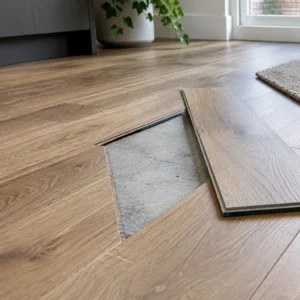
The main limitation is that carpet insulates more than many hard flooring options. Heat-up may feel slower when compared with a lower-resistance finish such as a compatible luxury vinyl tile. The system may also need to work differently to achieve the desired room temperature. Actual performance depends on insulation, glazing, room size, heat loss and system design.
Furniture placement can influence heat distribution too. Large items sitting flat against the floor can trap heat or reduce the useful heated area. Follow the heating and furniture manufacturers\’ guidance particularly for items with solid bases.
Choosing Carpet for a Heated Room
Start with the heating system\’s permitted floor-covering specification rather than choosing a carpet solely by appearance. Once the technical limit is known, compare compatible carpet and underlay combinations that suit the room\’s use.
For a busy hallway or commercial room, durability and cleaning requirements may be priorities. For a bedroom, softness and acoustic comfort may carry more weight. In each case, the combined tog rating and manufacturer approval remain essential.
All Type Flooring supplies and fits carpet for homes and businesses across Kent. A flooring consultation can help you compare carpet constructions, suitable underlays and fitting considerations. Any decision involving heating output, wiring, pipework or system controls should also be confirmed with the relevant underfloor heating specialist.
Frequently Asked Questions
Can existing carpet be used with newly installed underfloor heating?
Only if the existing carpet has a known tog rating and is approved for the proposed heating system. Its condition, backing and underlay must also be assessed. If product information is unavailable, replacing it with a clearly specified combination may be the safer decision.
Can rugs be placed on carpet above underfloor heating?
Rugs add another insulating layer and can trap heat. Check the heating system and carpet manufacturers\’ guidance before using one. Avoid thick rugs or rubber-backed products unless they are expressly approved for the floor temperature and build-up.
What temperature should underfloor heating use beneath carpet?
There is no single setting suitable for every carpet and system. Use the maximum floor surface temperature stated by the carpet and heating manufacturers. A compatible thermostat and floor sensor can help control the temperature.
Can carpet be fitted if the position of heating pipes or cables is unknown?
The heating layout should be identified before any grippers or mechanical fixings are installed. Plans, installation photographs or specialist detection may be necessary. A qualified heating or electrical professional should investigate where there is uncertainty.
Ask All Type Flooring about suitable carpet and underlay options for your heated room in Kent.